A Saddle and Two Wheels
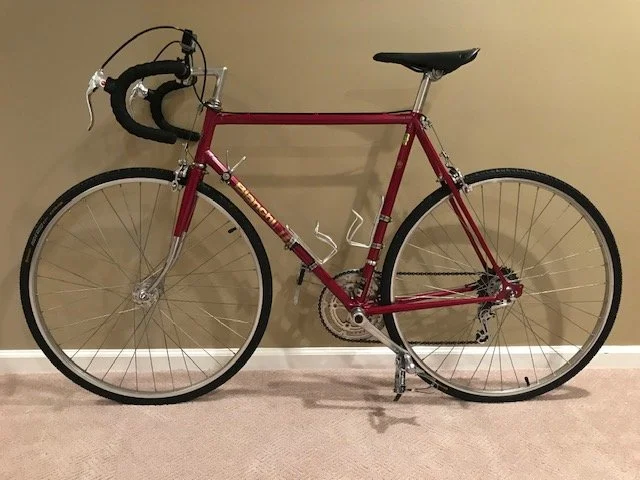
1981 Vintage Steel Bianchi
By Sterling M. Hawkins, MSW, LCSW-C, LICSW
Bicycles are the most efficient vehicles on the planet, 50 times more efficient than cars, and twice as efficient as walking.” -Godo Stoyke
I remember my first real bicycle. It was 1969, a red Sting-Ray with three speeds and a banana seat. There was a 3” wide slick rear tire and a smaller ribbed tire in the front. It had a sissy bar that could be extended for a passenger—no foot pegs. Foot pegs wouldn’t appear until the mid-1980s, when the popularity of the Sting-Ray bikes began declining in favor of the more versatile BMX bike that touted a stronger frame and other safety features that would lay the groundwork and inspiration for motocross.
In my neighborhood, there were no mountains or steep hills. Most streets around my house were less than a 5 percent grade. This was suburbia with plenty of asphalt. A few of the roads were crushed bluestone. This was my playground. Occasionally I would ride with one of the neighborhood kids, but most times I rode alone.
After outgrowing the Sting-Ray, during the 1970s I owned two more bikes. The first was a single-speed Schwinn cruiser. It was black, heavy, and indestructible. I believe one of my mom’s friends gave me the bike because it was no longer in use. The second bike was a hand-me-down from one of my cousins. This was the bike that cemented my love for road cycling.
The bike was manufactured by Steyr-Daimler-Puch, a large Austrian conglomerate, and marketed by Sears and Roebuck department stores in the US under the name Free Spirit. It was white with red and blue lettering and pin-striping on sections of the frame. It was also a steel bike, but unlike the previous bikes, this one was Chromoly steel, a thinner, lighter alloy than the heavier High Tensile steel I was accustomed to. The bike was worn, but functional. And with a little work, it became my primary mode of transport for trips within a couple of miles of home. This was my first ten-speed. I learned proper gearing and spent hours in the saddle.
One summer, on most weekdays, I would complete a 14-mile round trip from my home to my aunt and uncle's and back. I was about fifteen. At the time, “kits” (the traditional synthetic attire worn by most cyclists) were available only from bike shops and specialty sports catalogs. So instead, I donned a pair of close-fitting shorts or denim jeans with the pant legs cuffed, paired with a short-sleeved T-shirt, baseball cap turned backward (bicycle helmets were not considered standard safety gear until the late 1980s), and a light backpack containing a few tools and a spare tube, and I was on my way. This bike also helped introduce me to family caregiving. Let me explain.
My aunt and uncle were both retired, elderly, and had both experienced significant decline. In fact, the purpose of my daily commute to their home was to help them during the day with their meals and some cleaning, until another one of my aunt’s sisters or my mother stopped by after work. My aunt had been diagnosed with advanced multiple myeloma. She was quite frail and moved only a short distance in and around the tiny rambler both she and my uncle occupied. My uncle, in his late seventies, was still as strong as an ox, ambulatory, and independent with activities of daily living. However, he had been recently diagnosed with “hardening of the arteries” the term historically used to describe Dementia. He wasn’t supposed to drive, although he did, and I often accompanied him to help him navigate and direct him safely to the few places he frequented before his keys and eventually his car were taken away.
In 1981, while home from college for the summer, I took my first serious road trip with a friend. We both decided it was time to purchase new bikes. So, we did. I purchased a budget Italian-made base-model road bike (Bianchi, pictured above), and my friend purchased the same brand, but a competitive model with a higher-end groupset (Campagnolo) than mine (SunTour).
We traveled the back roads, approximately 120 miles from DC to Lancaster, PA, in just under twenty hours. We slept overnight under a bridge outside Baltimore, leaving at dawn the next day and arriving at our destination around sunset. We did this ride using only a paper map. Remember this was 1981. It would be another eight years before GPS units became available for the average consumer. We arranged with another mutual friend who had a van to meet us in Lancaster and drive us and our bikes back to DC. It was an epic trip, and another experience that sealed my love for cycling.
In the years that followed, I spent more time off the bike than on it. These were transitional years. In 1983, I moved back home to Maryland and then returned to Illinois a year later to finish my degree. It was 1985. In the same year after returning to Maryland, I was offered a job in Florida by the Executive director of the state nonprofit organization I met while interning as an undergrad at the national office in DC. I loaded my bike and whatever else I could fit into my Volvo and headed to Florida.
In 1987, while living in Florida, I quit my job and went back to school full-time to complete my Master's. During this time, I rode infrequently, except for leisure and the occasional one-mile commute from my apartment to campus. Even with near-perfect weather in the Sunshine State, I cycled far less than I expected. During this time, I maintained the Bianchi and rode only when I felt I could not do otherwise.
I returned to Maryland in 1990, and life got busy. I eventually found employment, moved out of my mother’s basement, met my future wife, and got married. All within two years after my return. In 1994, my wife and I had our first son. A second son followed in 1997.
In the years that followed, I cycled only occasionally. While I purchased a bike and a scooter for my sons, they took up other sports (basketball, football, and soccer). Therefore, trips to the local park where both could ride without traffic were few.
While I always maintained my personal fitness and, for years, frequented the gym, I was a casual, seasonal cyclist at best. For the past twenty-plus years, I only cycled infrequently when and where I wanted to. That all changed in 2020.
In 2020, I took to the road again. It was the height of the Pandemic. The road was the only place where I felt comfortable, free. So many people were becoming ill from the virus. I became very depressed as I watched thousands die helplessly. Working in home care as a clinical social worker, with chronic and terminally ill patients, put me and those working with me on the front lines. Our patients were already in a vulnerable state and dying from other diseases. COVID only made it worse. I lost a work colleague to COVID. It was sudden, and it took me some time to grieve and process the loss, along with other patients assigned to me who were dying even without contracting the disease. Life seemed incredibly fragile and uncertain. There seemed to be no end.
I sold the Bianchi that year for a fair price and began searching for a lighter carbon-framed bike that would allow me to ride longer distances. I found the bike I was looking for in the size and color I wanted- a 2020 Giant Defy. Charcoal black, with a Shimano 105 groupset. A couple of local bike shops didn’t have my frame size, so I was forced to search online retailers.
I found a retailer in Wisconsin. The bike was used as a display model and was brand new. One of the store’s owners agreed to do a video call. She showed me the bike up close as I had her direct the camera to its parts. She assured me that it would be disassembled and properly packed for shipping. Within a few minutes, the credit transaction was complete.
Within seven days, FedEx delivered my bike, and I used a local bike shop I knew to help with much of the assembly because I lacked the proper tools. This particular bike was a mid-range bike with components my previous bikes didn’t have. Like internal cable routing, trigger shifters, and disc brakes. It had a full carbon frame, light and fast, with a 50/34t crankset and an 11/34t cassette for climbing hills. It was a mechanical gem, and I felt good in the saddle.
No longer a youth and needing some motivation to reach a level of fitness that would increase my tolerance, I turned to a couple of local cycling clubs that held weekly rides. I joined two clubs on Meetup: both with Class B and C riders who scheduled Fondos (long-distance, mass-participation road cycling events on most weekends, varying in length, averaging 20 miles). I also created a Strava account to track my own fitness and the accomplishments of other riders I knew.
For the next two years, I rode as often as my schedule, the weather, and my health permitted. I reached a level of fitness that felt good. I completed a few city-to-city rides of 40-50 miles and made a few friends along the way.
Now in my mid-sixties and retired, I’ve entered another transitional phase. Balancing quantity with quality and giving up chasing the numbers. My life is full. I currently volunteer with a local health-care coalition, serve as a consultant to senior communities, co-facilitate a grief group, and still see one or two psychotherapy clients. I try to cycle at least two to three days a week indoors, along with performing other weight-bearing exercises. If the weather’s nice on a weekend, I’ll saddle up for at least 12 miles. Some days, if I’m not feeling the bike, I walk 2 to 3 miles and feel better afterward.
My purpose for writing this is to encourage readers to prioritize their physical health. Cycling is only one of many recreational activities that fuel mind and body. The literature is filled with peer-reviewed research. These varied studies basically reach the same conclusion— Keep moving if you want to go far and live long. Research has shown that regular exercise reduces anxiety and depression, sharpens memory, improves sleep, and builds self-confidence through small, sustained achievements. Exercise may also improve your social life and allow you to connect with others who share similar interests.
To develop consistency and sustain motivation, it should be an activity you can complete independently, and that leaves you feeling better, more balanced, and less stressed than when you started. If you miss a day or two, don’t quit, don’t give up! Pick up where you left off at your very next opportunity. Don’t delay!
Don’t have enough time to do a full workout? Just do 15 or 20 minutes. I’ve learned over the years that, with cycling, as with other seasonal sports, the off-season is more important than the regular season. For most amateur cyclists in cold weather regions, the season runs from April to September. These aren’t rigid timeframes; they serve only as a guide. As you age, it takes longer to return to pre-season readiness if you’ve been inactive during the off-season. For me, living in Maryland, that’s from October to March.
In 2022, I purchased a stationary spin bike to ride indoors and paired it with a second used 2011 Specialized Tricross, I purchased as a back-up bike to ride during the winter months. I also use an old set of bicycle rollers indoors over the winter months, when temperatures dip below freezing and ice and snow cover the ground.
Every little bit helps preserve your functional mobility so you can do the things you love. No matter how long I’m out of the saddle or off the bike, I’m committed to never being past the point of return. I ride to live. So, whatever form your fitness journey takes, just do it! Add years to your life.
“A lack of activity destroys the good condition of every human being while methodical physical exercise save it and preserve it.” —Plato