A Psychological Approach to Wellness: AN INtroduction

Photo by Madison Lavern
By Sterling M. Hawkins, MSW, LCSW-C, LICSW
We are hardwired for the drive toward human potential. And, only when we have been stripped of the foundational building blocks that move us toward life will our initiative toward satisfaction and fulfillment cease. This is a complex topic that I cannot hope to examine thoroughly in a few pages. My intent here is to briefly explore what factors contribute to or detract from individuals reaching their full potential.
Cognitive Behavior theorists and Health Practitioners are mostly in agreement that our intrinsic construction requires that our physiological and psychological needs be met to avoid ill health. Abraham Maslow, PhD, (1908-1970) and others like him identified the foundational building blocks that lead to achieving fulfillment in life. Maslow did this using a hierarchical arrangement familiar to most. Maslow identified 5 Needs common to all humanity, regardless of ethnicity or culture. He uses a pyramid to illustrate how each of these physical and psychological needs is interdependent, enabling one or more other needs to be met in succession.
It can be said that social and cultural differences may affect the identification or expression of such needs to varying degrees, but the needs themselves remain evident. Below is an example of the 5 Needs he identifies common to the human species. The most important needs, which are physiological, are identified at the base of the pyramid with psychological needs that are subsequent and dependent on the physical or environmental needs closer to the top. Maslow believed that optimal health results when each of these needs has been met. And, throughout our lives, we are attempting to reach our full potential. Maslow would refer to this as becoming “self-actualized,” which he defines as the final state of an individual's linear growth. Moreover, self-actualized individuals understand their abilities and limitations and experience a drive to be creative in all aspects of their lives. Because this is a linear model and self-actualization would not occur without more basic or environmental needs being met first, not everyone will reach self-actualization. From this hierarchy, we learn that self-actualized individuals, regardless of background or occupation, can cultivate deep, meaningful relationships with others.
I will talk more about the role of the environment, which I believe is a critical component when examining optimum wellness, a bit later. Let’s continue our examination of Maslow’s theoretical framework for wellness. In his book titled Toward A Psychology of Being, (Wilder Publications, 2011) Maslow in Chapter 5 on Values defines 10 characteristics of the healthy human specimen. Given that the usage of the term “health” means different things relative to the context of reference, Maslow attempted to provide a universal definition, notwithstanding socio-cultural distinctions.
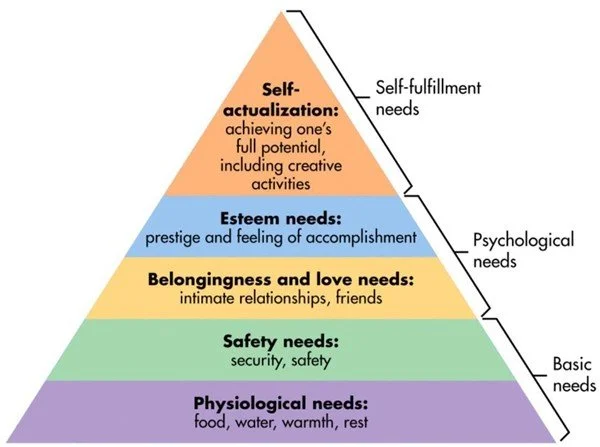
Figure 1: Maslow’s Hierarchy of Needs
A Universal Definition of Health
1. Clearer, more efficient perception of reality
2. More openness to experience
3. Increased integration, wholeness, and unity of the person
4. Increased spontaneity, expressiveness, fully functioning
5. A real self, a firm identity; autonomy, uniqueness.
6. Increased objectivity, detachment, transcendence of self.
7. Recovery of creativeness.
8. Ability to fuse concreteness and abstractness.
9. Democratic character structure.
10. Ability to love, etc. (Maslow, 2011, pp. 120-121)
There is significant overlap in this list. However, his point is that all healthy people, to varying degrees, should possess several of these traits. And the absence of these traits would indicate a lack of health or a diseased state.
While the intended effort is to generalize these traits, it is clear that this approach creates some empirical challenges. Namely, the creation of a naturalistic values system that differentiates subjective freedom of choice. Maslow writes, “Healthy people, permitted to choose freely, are observed to choose this or that. His is like asking, “What are the values of the best human beings,” rather than, “What should be their values?” Or, what ought they be?” (Maslow 2011, p. 121)
Another complication cited is that the transcendence of selfish and personal motivations entails giving up “lower” desires in favor of “higher” ones. An example of this is the effort to differentiate between intellectual and peaceful pursuits and the desire for money, power, and status.
He concludes that self-actualization is a relatively achieved “state of affairs” in a few people, that can be described as a hope, a yearning, a drive, a something wished for but not yet achieved, showing itself clinically as a drive toward health.
The drive toward human potential, while inherent in each of us, is not a constant. It is subordinate to both a physical and mental state of being that is not in conflict within the individual. The biological term for this state of being is homeostasis.
Homeostasis is best defined as the self-regulating process by which organisms maintain stability while adjusting to conditions that support their survival. An example of this would be maintaining a healthy blood pressure.
The heart can sense changes in blood pressure, sending signals to the brain, which then sends specific instructions back to the heart. If blood pressure becomes too high, the heart should slow down; if it becomes too low, the heart should speed up. Other examples include pH, sodium, and glucose levels in the body. The human body requires specific homeostatic mechanisms to sustain its optimal functioning. Optimal functioning is dependent on a given homeostatic range. If we move outside of this range, an imbalance is created. And if this imbalance persists and the body can no longer perform its normal functions, the living organism will eventually become dysfunctional, fail, and die.
What becomes clear is that homeostasis depends on multiple variables. Some of which we know little about. Our lack of this knowledge is what drives us to conduct research on various systems (human, biological, environmental, and mechanical) and to learn how to identify and manipulate specific variables to achieve desired outcomes.
I will now return to the environment as a factor in determining wellness, because I believe it is a necessary variable that can drive positive outcomes in wellness.
When I was preparing to leave Chicago in the early 1980s, several years after completing my studies, I remember focusing on the environment, which had become etched in my psyche. I wanted to capture my thoughts and emotions associated with that experience. I wanted to capture and reflect on specific aspects of that experience in the future. I wrote in my journal-
“I’m counting all the people, places, and things that I hold. Like a garden filled with flowers on a bright sunny day, a walk downtown on icy, covered sidewalks. The aroma of food from restaurant kitchens. The smile of a lady inside the market. Walking alone on a littered beach. Running laps at Lake Shore Park. The books, the classes, exams, and papers. Deep thoughts, profound truths, serious emotions, empty chatter filled with laughter, sorrow, and shame. A man named Bill in Cabrini. I read to him. Sippin' coffee at McDonald's with a lady named Bernice. Janitorial work at night in the campus kitchen and weekend jobs in old Greystones on the North Shore. Riding the L both north and south of the city. Worship on Sundays in the inner-city and in the outer-suburbs…”
These thoughts are linked to a material environment with people and things. And whenever I read this entry, I mentally rehearse these experiences. Many of these experiences helped me move closer to becoming more self-actualized, in Maslow’s terms. A few experiences during this time also pushed me further away.
We each do this when we take a photograph with our camera, or save an obituary or a letter written to us by a loved one. Or, when we purchase a book after meeting the author or a recording after attending a live performance. These environmental markers influence our lives in unique and memorable ways, for better or worse.
If we’re fortunate, environmental experiences will produce more positive than negative influences in our lives and give us a sense of accomplishment, enabling us to move closer toward reaching our full potential.
To Maslow’s credit, he clearly identifies the challenges in doing so. He cannot do otherwise because his worldview is both static and linear, placing the burden entirely on the human organism to resolve the problems that prevent us from becoming self-actualized. Maslow is a psychologist and is just being consistent with a cognitive-behavioral approach toward wellness. However, there’s a missing element— trauma and its impact on the human condition, and the cognitive distortions that arise from trauma that dismantle Maslow’s neat pyramid. His system hints at this but excludes what more recent theorists consider a key factor within psychodynamic theory- when viewed through the lens of neuroscience, and how cognitive distortions interfere with social and emotional regulation, and the drive toward self-actualization. Neuroscience, I believe, is the missing link that was historically unavailable to Maslow. It began to emerge soon after his death.
When cognitive distortions are identified, we are better able to tailor treatment approaches that remove impediments to psychological growth and encourage behavioral change. We strengthen our resilience to the effects of deeply distressing or disturbing experiences known as trauma.
To examine the literature more closely and extract the findings cited by neuroscience research that impact health, I recently read “The Body Keeps The Score” by Bessel Van der Kolk, MD. The book is a comprehensive and informative guide to the science of trauma and its treatment. It provides a compassionate and accessible look at this complex topic, offering hope and practical strategies for recovery.
What sets this book apart from others that address the subject of trauma research is that the author is both a psychiatrist and researcher with a long history of measuring the effect of trauma on brain function, memory, and treatment outcomes, in addition to being an active therapist who keeps learning from his patients what benefits them most.
The central theme of the book is to demonstrate how trauma reshapes both the brain and body, impacting memory, emotions, and even physical health. The book explains the brain–body connection, how trauma can lead to chronic stress and pain, why survivors may feel stuck in the past, and how healing is possible. van der Kolk’s findings are essential to view alongside behavioral theories like Maslow’s because they explain why such theories alone fail to address the biopsychosocial factors that prevent self-actualization.
In the summaries that follow, I will highlight key points from the book and present my general conclusions.
___________________________________________________
References:
Maslow, A. H. (2011). Toward a psychology of being. Wilder Publications.