When craft becomes art: How We Honor Those Who Love Us
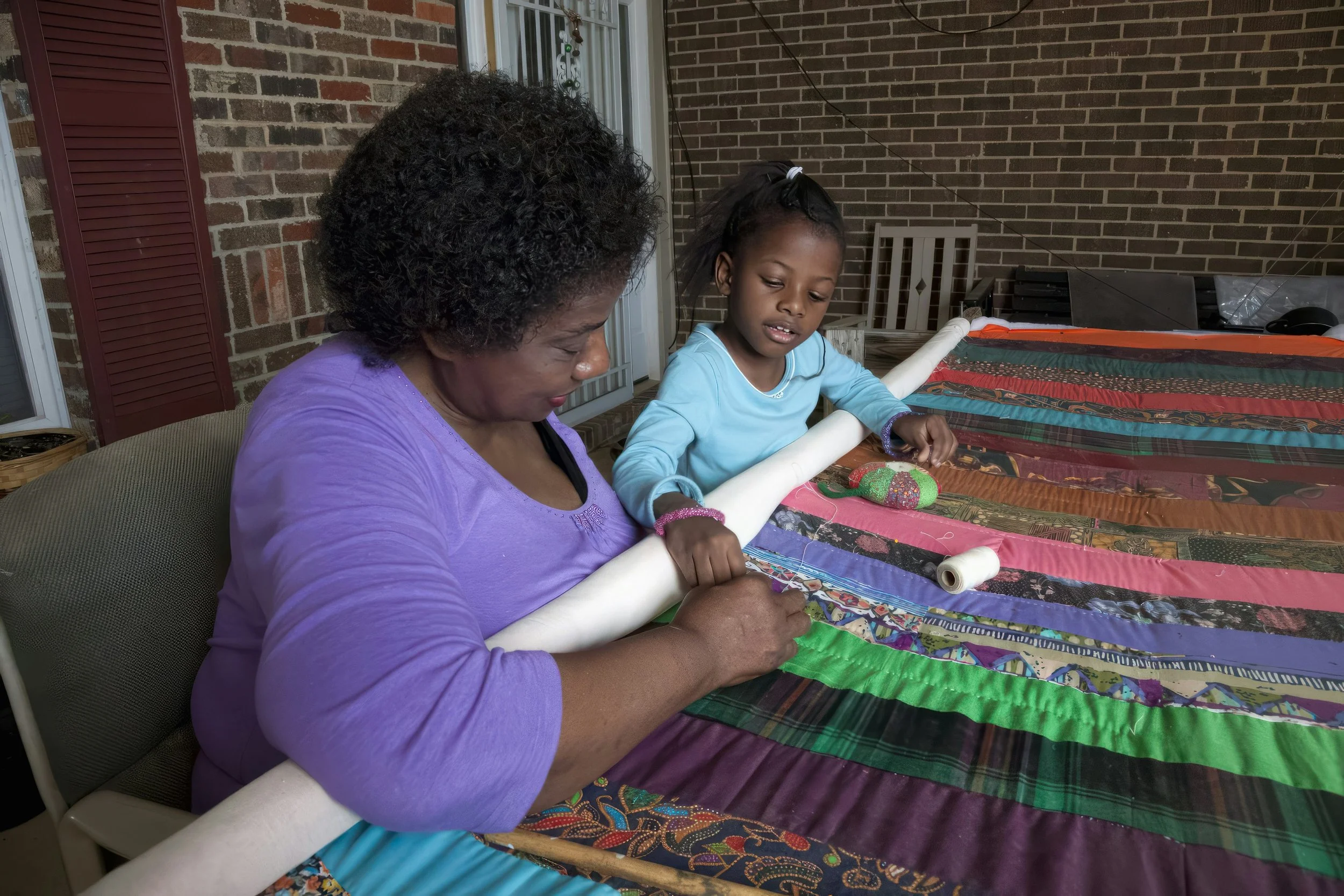
Photo by Carol Highsmith
By Sterling M. Hawkins, MSW, LCSW-C, LICSW
While reading through the literature for Retracing Our Paths, I began to reflect on what has been lost. Every society and culture experiences loss. The question is not whether loss will occur, but what things should we preserve and protect from becoming absent and unknown? Generally, most cultures that become industrialized lose some of their distinct identity. This is expected. However, often what remains after men and women who hold the knowledge of their craft die is an incomplete history.
It is said that craft focuses on skill and utility, whereas art emphasizes creative expression and aesthetic or intellectual content. A craft is often functional, but the materials used or the process in which it is made, traditionally, can elevate materials beyond their specific purpose. In some cultures, there is no distinction made between craftwork and artistic expression. They are seen as one.
An example of this is found in the photograph at the top of this page. Quilt making, or “Quilting” as it is called, is the process of joining several layers of fabric together, either manually using a needle and thread or mechanically with a sewing machine. The photo depicts a woman and a young girl sitting at a quilting frame. Although not explicitly stated, something is transpiring between the woman and the girl. The woman is closely observing the young girl and perhaps assisting the girl with a stitch on the quilt that is stretched over the quilting frame. The hands of both the woman and the girl appear to be touching as they rest on the quilt. Because the photographer doesn’t write the narrative for us, we must use our own imagination and social references to conclude that a form of communication and knowledge is being shared between the two.
It’s this exchange, and what is verbally acknowledged and visually observed in both the woman and the young girl, that moves the task from being purely functional to an expression aimed at creating a powerful social and cultural narrative, transforming their quilt-making from craft to art. Perhaps the two are related, and biological and emotional bonds already exist between them, which the process of quilting is helping to mend. However, we are not told this. It is only my assumption. What is important are the stories that are told, remembered, and passed on long after the quilt is gone.
The young girl is witnessing and receiving instruction on the craft— knowledge. How to make a quilt, its purpose, and its function as a covering for warmth. Along with its functional purpose, the quilt also serves to preserve a valuable skill that reinforces identity, independence, and creativity. Since all sewing was initially done by hand, it became essential for one's survival.
A quilt, similar to a book, has many pages in the form of cloth patches of varying sizes, shapes, and colors. The process of producing a quilt usually involves two or more women working together for months at a time. It is often pieced together by hand, requiring close stitching and the coordination of cloth by pattern, size, shape, and color. It is a learned skill that has to be taught and is therefore educational.
Like most crafts, the art of instruction is the life stories we share about how to live and navigate in the world of work. How to collaborate with people who disagree with us. How to suffer and celebrate the seasons of life and seasons of the heart.
Each quilt tells a story. If you listen to the women (and some men) who are quilters, you will discover how they trace their history and family origins using the cloth patches sewn into the quilt during its creation. These oral histories are repeated many times over to eventually become lore.
The quilt then transforms into a “living” cloth, known best by those who labored to fashion it. Quilts then become a tapestry filled with old and new fabrics that tell the stories of a generation.
The aesthetic beauty of these finished works is appreciated by many. But if they are to be fully treasured as works of art for their value by others unfamiliar with the craft, the story of each quilt must be told separately.
* * * *
My grandmother lived to be ninety-eight and retained her cognitive function until the very end. She created numerous quilts throughout her lifetime. She worked independently, sewing by hand and using a 1953 treadle Singer machine that she purchased new.
My grandmother was a storyteller who told stories that made others listen intently and laugh often. She enjoyed reminiscing about farm life, sharecropping, and her childhood experiences and relations with other family, friends, and strangers.
She died in 1998 and lived not far from where I grew up. I spent several summers with her and have fond memories of sitting in her kitchen while she prepared more food than I could eat in one meal. She was used to preparing meals for large households and had difficulty unlearning this skill, even when caring for just me. My grandmother was spiritually aware of her role in life and lived with a sense of purpose and grit. She had a deep knowledge of the soil and crops and maintained a small garden plot that she worked independently into her eighties.
As a young woman, she worked in kitchens and helped out in the fields. And even served for a brief time as a birth midwife, assisting with the delivery of several children.
Warm summer evenings were spent sitting on her screened porch, listening to crickets and watching whippoorwills dash about in the darkness. We counted fireflies and expressed imagination and curiosity at the sounds of the night. It was during these times that she would often tell stories of her migration, searching for work and living in substandard housing, surrounded by strange sights and sounds. Occurrences that were nothing less than paranormal.
My grandmother enjoyed collecting material for quilting. She had grocery bags and boxes full of fabric and clothing that she would use. She proudly showed me these and told stories about how she got them and planned to use them in sewing quilts.
Sadly, for me, those stories have faded, like black-and-white photos that have succumbed to the passage of time. A few photos, her sewing machine, and two quilts are all that remain of her visible legacy. I wish I had recorded the stories that go with them. Her life experiences are what matter to me. The artifacts from her life are ways that I choose to still connect with her. Only then do they become valuable and can be labeled as art. True art always tells a story.
In 1984, I attended a performance at the Kennedy Center in Washington, DC. The play was titled “Quilters”. It is a play set in the Midwest colonial era that depicts the role that women played in the work of caring for hearth and home. Quilting and other forms of textile work were used to produce bed coverings, window and door coverings, and clothing designed for warmth.
I was a young college student at the time, and inspired by the play. So, I penned the following poem —a tribute to the legacy of labor from women like my grandmother. Women of all races and nationalities who contributed to the greatness of the United States in ways that today receive little recognition. I believed then, as I do now, that their sacrifices and arduous work should not be forgotten or obscured in the retelling of our history.
* * * *
Q u i l t e r s
Caught on the edge of the present and days gone by. A trip into the lives of American women and the way they shaped our heritage through craft. The beauty of them all. Both young and old. I salute you.
You whose eyes have seen the seasons of the year unfold, both good and bad. You were there to bear the weight of all our troubles and preserve our traditions.
You, whose able body brought fruit from the womb, and names that would be remembered for generations to come.
You, whose words were well spoken and whose songs were a joy to hear. They served as a guide and a warning.
For the feet that have walked the breadth of this land and carried little ones from house to house, pails of water from the well, wood from the forest, and sacks of grain from the barn to the fields.
And for all of the women whose strong arms and hands preserved the stories of our lives through their art in the American tradition.
—S.M. Hawkins
I now return to the question I asked at the beginning—What things should we preserve and protect from becoming absent and unknown?
I believe the answer is found in the things that remind us of who we are, where we've come from, how we have changed, and how we have not. Timeless things that define our inward character and not just our outward appearance. Things that cause us to believe that we can learn from everyone about what is good and what is not. Things that will destroy kinship and family relations, and things that will preserve these relationships, keeping them strong and bound in ways that are healthy. These characteristics are inherent in the soul or ethos of all people.
Restarting conversations and resuming the rituals of coming together requires supporting the efforts of individuals, families, and groups within our communities engaged in a skilled craft, whatever it is. And by identifying shared experiences, opportunities for mentoring, and committing to work collaboratively on goals that rebuild trust, we can then prepare those who will follow us.
As a clinical social worker, I believe that these practices should be integrated into the way we retell our stories, whether they are pleasant or painful. When we do this, we create a space for reflection, healing, and rediscovering who we are, where we are going, and what we are becoming as individuals and as a culture. If we do these things well, the outcome will be a legacy that will influence future generations.
In the words of Eric Overby, “We never fully move on; we leave a piece of ourselves behind like leaves and trunks molded into the earth and the forest floor. We give what we know, and others take it up and use it to grow. [We] stand under the shade of giants.”
_______________________________________________________
References
PBS NewsHour. (2022, March 26). Famed Gee’s Bend Quilters are now on the runway and online [Video]. YouTube. https://www.youtube.com/watch?v=0QdGxVXPCME
Women’s Theater Workshop. (2019, April 21). Women’s Theatre Workshop Quilters by Molly Newman and Barbara Damashek [Video]. YouTube. https://www.youtube.com/watch?v=wqMGE3h0BuU